Art and language: performance
There is a manifest relation between language and art. This link has become more and more visible with the recent evolutions of art, let’s say for fifty years. But the relationship between speaking and creating seems to be a very wide spread fact, if not a universal one. For what concerns our culture, this is a common statement that creating has been associated to word since the fundamental texts referring to creation are always structured by a performative1 utterance: it is for example the case with the “fiat lux” of the genesis or with the beginning of the Gospel of John, that claims:
“In the beginning was the Word, and the Word was with God, and the Word was God.”
 Let’s take a look
at the context of the slight shift that allowed a new link between
art and language to take place. A significant element is the
linguistic turn that occurred in philosophy at the beginning of the
20th
century. A revolution happening in mathematics and related to logics
had a strong influence on philosophy, and a new branch appeared,
mainly in Anglo-Saxon countries, which we can call “analytic
philosophy”. Its aim was to undertake the logical clarification of
language in order to reject some of the traditional questions asked
in metaphysics. The great names associated to the beginning of
analytic philosophy are Frege and Russell. But the greatest influence
of analytic philosophy on art comes from Ludwig Wittgenstein. The
large impact of his work can be estimated if we consider how
conceptual artists often refer to him. An other revolution concerning
language happened approximately at the same time: it is the invention
of psychoanalysis by Sigmund Freud. He showed that the structure of
language implements an unconscious mind. On the artistic level this
discovery gave raise to surrealism. We have then found two main roots
for the renewed occurrence of language in art, and we can link it to
two names: Freud and Wittgenstein.
Let’s take a look
at the context of the slight shift that allowed a new link between
art and language to take place. A significant element is the
linguistic turn that occurred in philosophy at the beginning of the
20th
century. A revolution happening in mathematics and related to logics
had a strong influence on philosophy, and a new branch appeared,
mainly in Anglo-Saxon countries, which we can call “analytic
philosophy”. Its aim was to undertake the logical clarification of
language in order to reject some of the traditional questions asked
in metaphysics. The great names associated to the beginning of
analytic philosophy are Frege and Russell. But the greatest influence
of analytic philosophy on art comes from Ludwig Wittgenstein. The
large impact of his work can be estimated if we consider how
conceptual artists often refer to him. An other revolution concerning
language happened approximately at the same time: it is the invention
of psychoanalysis by Sigmund Freud. He showed that the structure of
language implements an unconscious mind. On the artistic level this
discovery gave raise to surrealism. We have then found two main roots
for the renewed occurrence of language in art, and we can link it to
two names: Freud and Wittgenstein.
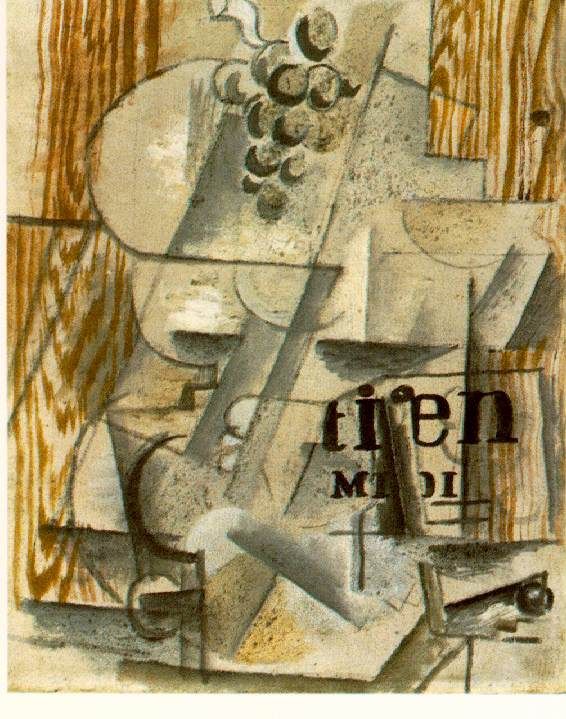
Th e place of language in surrealism is crucial, since the main
manifestation of this current occurred on the literary level. With
surrealism, we can’t separate any more writing from drawing. André
Breton expressed it in his definition of surrealism, given in the
first Surrealist Manifesto: the purpose of surrealism is “to
express, either verbally, in writing, or by any other manner, the
real functioning of thought”. The artists’ practice tended indeed
to mix all the ancient domains. That can be seen as the consequence
of one of the main features of surrealism: liberation of the human
mind from its institutional frame. This blending of many different
practices is visible with the collages. This practice is inherited
from dadaism and cubism. Braque already used words in his paintings.
With surrealism, dadaism and some other trends that often refer to
these two movements (as, for example, situationism and Guy Debord’s
practice), we then have a unified field of artistic practices
involving language. Their unity is provided by a particular way of
using words on the image. One important feature is the “non
sequitur”, that characterizes the link between the text and the
image or, to be more accurate, the absence of link between the
elements. Language occurs here in the general frame of free
association in order to destroy any logical stranglehold, that would
be an institutional stranglehold.

 It’s
an acknowledged fact that Marcel Duchamp is the father of conceptual
art, since he first allows artists to play on the conceptual field.
The ready made is not a work of art by itself. In fact, we should say
that the work of art lies in the analysis of the presentation of the
ready made in a museum. This object is not art but its situation is
art. That little gap between the object and its situation introduces
the possibility of conceptual art. The new problem of art is then to
answer the question: does art lie in the object that embodies the
idea, or does it already lie in the idea itself? The immediate
corollary is: Is the realisation necessary, or can the work of art be
independent of any embodiment? With these considerations, we clearly
can see that what is difficult and interesting with conceptual art is
that it plays on a philosophical level. We could say that the “raison
d’être” of conceptual art is this questioning about art.
And this questioning can only take place in language, because this is
the only medium that is sufficiently articulated to provide a field
for reflection. Marcel Duchamp’s ready made introduces language
with the signature of the artist. This little scrabble implies an
entire discourse about the work, it’s condition of exposition and
the definition of art adopted by the artist. Like in psychoanalysis,
a lonely word is an efficient cause that can give raise to hours of
talking. With the ready-made, the situation of the work (in a
gallery, or in a museum) becomes certainly important, but we could
say that the whole artistic act relies in the performative utterance
of the artist saying: “it is a work of art”, and that utterance
relies in the signature.
It’s
an acknowledged fact that Marcel Duchamp is the father of conceptual
art, since he first allows artists to play on the conceptual field.
The ready made is not a work of art by itself. In fact, we should say
that the work of art lies in the analysis of the presentation of the
ready made in a museum. This object is not art but its situation is
art. That little gap between the object and its situation introduces
the possibility of conceptual art. The new problem of art is then to
answer the question: does art lie in the object that embodies the
idea, or does it already lie in the idea itself? The immediate
corollary is: Is the realisation necessary, or can the work of art be
independent of any embodiment? With these considerations, we clearly
can see that what is difficult and interesting with conceptual art is
that it plays on a philosophical level. We could say that the “raison
d’être” of conceptual art is this questioning about art.
And this questioning can only take place in language, because this is
the only medium that is sufficiently articulated to provide a field
for reflection. Marcel Duchamp’s ready made introduces language
with the signature of the artist. This little scrabble implies an
entire discourse about the work, it’s condition of exposition and
the definition of art adopted by the artist. Like in psychoanalysis,
a lonely word is an efficient cause that can give raise to hours of
talking. With the ready-made, the situation of the work (in a
gallery, or in a museum) becomes certainly important, but we could
say that the whole artistic act relies in the performative utterance
of the artist saying: “it is a work of art”, and that utterance
relies in the signature.